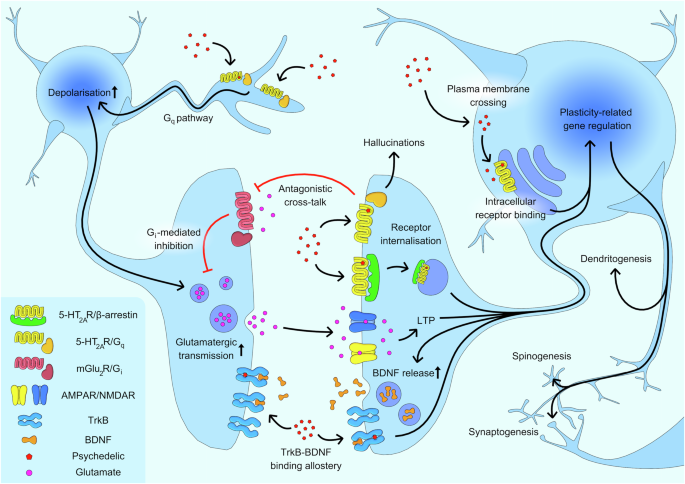
Psychedelic substances have gained renewed interest for their potential to treat mental health disorders, especially depression. Central to their effects is the 5-HT2A receptor, a subtype of serotonin receptor that plays a crucial role in modulating neuroplasticity—the brain's ability to reorganize itself by forming new neural connections.
Research indicates that activation of the 5-HT2A receptor by psychedelics such as psilocybin and LSD leads to significant changes in brain connectivity and plasticity. These changes are believed to underpin the rapid and sustained antidepressant effects observed in clinical studies. Unlike traditional antidepressants, which often take weeks to become effective, psychedelics can induce neuroplasticity and mood improvements within hours.
The mechanism involves the stimulation of the 5-HT2A receptor on cortical neurons, which triggers a cascade of intracellular signaling pathways. This activation results in increased expression of neurotrophic factors like BDNF (brain-derived neurotrophic factor), promoting synaptogenesis—the formation of new synapses—and dendritic growth. Such structural changes are associated with enhanced neural network flexibility, crucial for overcoming rigid negative thought patterns characteristic of depression.
Furthermore, neuroimaging studies have demonstrated that psychedelics reduce activity in the default mode network (DMN), a brain network associated with self-referential thought and rumination. The disruption of DMN activity correlates with a dissolution of the ego and a sense of interconnectedness, which can facilitate psychological breakthroughs and emotional release during psychedelic therapy sessions.
Preclinical studies support these findings, showing that 5-HT2A receptor activation increases neuroplasticity markers and promotes resilience against stress-induced neural changes. These effects are not solely due to receptor activation but also involve downstream signaling pathways, including the mTOR pathway, which is critical for synaptic protein synthesis and plasticity.
Despite promising results, the exact mechanisms by which 5-HT2A receptor activation leads to sustained antidepressant effects remain under investigation. Researchers are exploring how different psychedelic compounds vary in their receptor affinity and signaling bias, which could influence therapeutic outcomes and side effect profiles.
In conclusion, the 5-HT2A receptor is a key mediator of the neuroplastic and antidepressant effects induced by psychedelics. Understanding its role offers valuable insights into developing novel treatments for depression that harness the brain's capacity for change, potentially revolutionizing mental health therapy in the future.